PART I:
The Genesis and Formative Years
(1983-1995)
The Foundation of a Vision: A Promise Made
Early Milestones and Outreach: The Clinic on Wheels
“Your health matters. You are seen.”
The early awareness campaigns were ingeniously tailored to the era. In a time before social media, they used newspaper advertisements and, most evocatively, slides screened in movie halls before the feature film. In the darkened theatre, amidst the anticipation of entertainment, a quiet, vital message about early detection would flicker across the screen. They were capturing hearts and minds in moments of leisure, planting a seed that could one day save a life. In formal meetings was arranged with volunteers who eagerly joined in to offering their service before self.
Expanding Services and Reach: Building Trust in Seema Puri
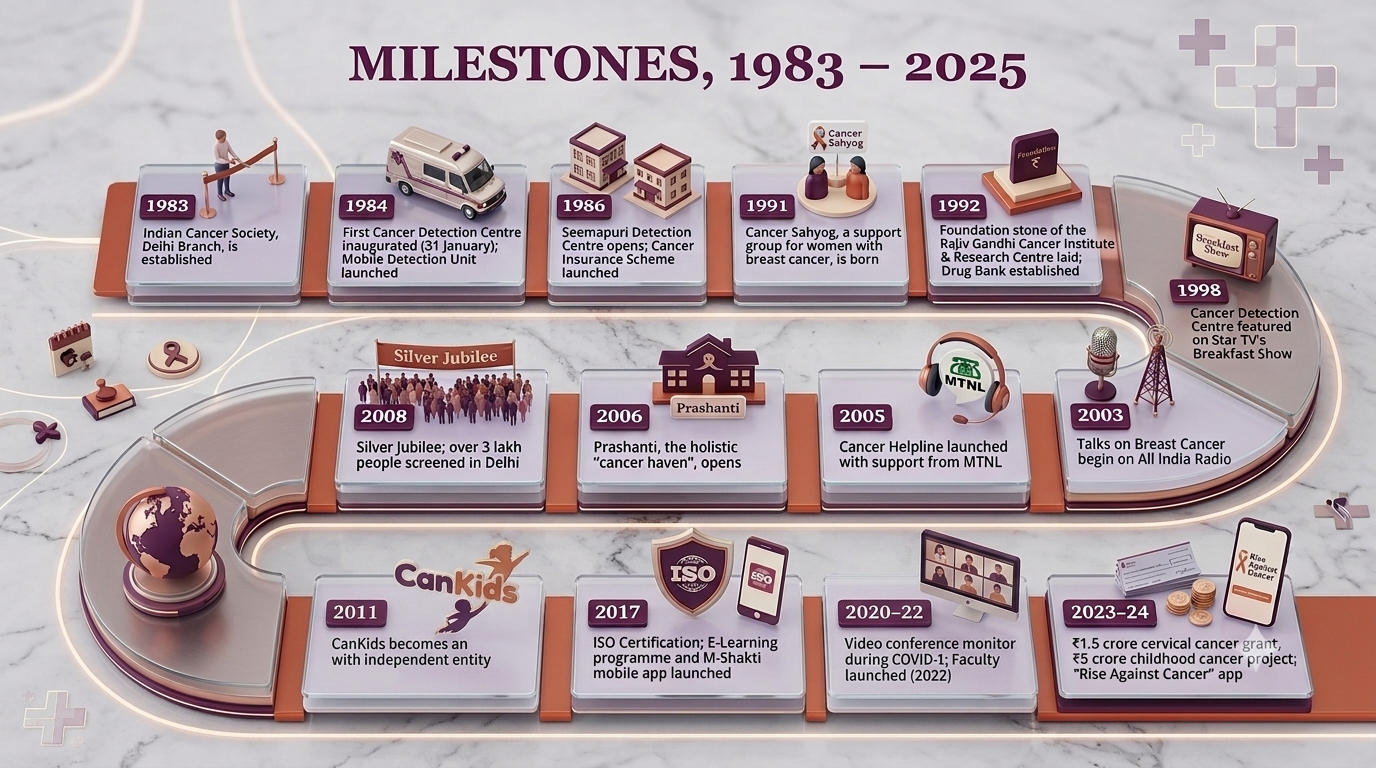
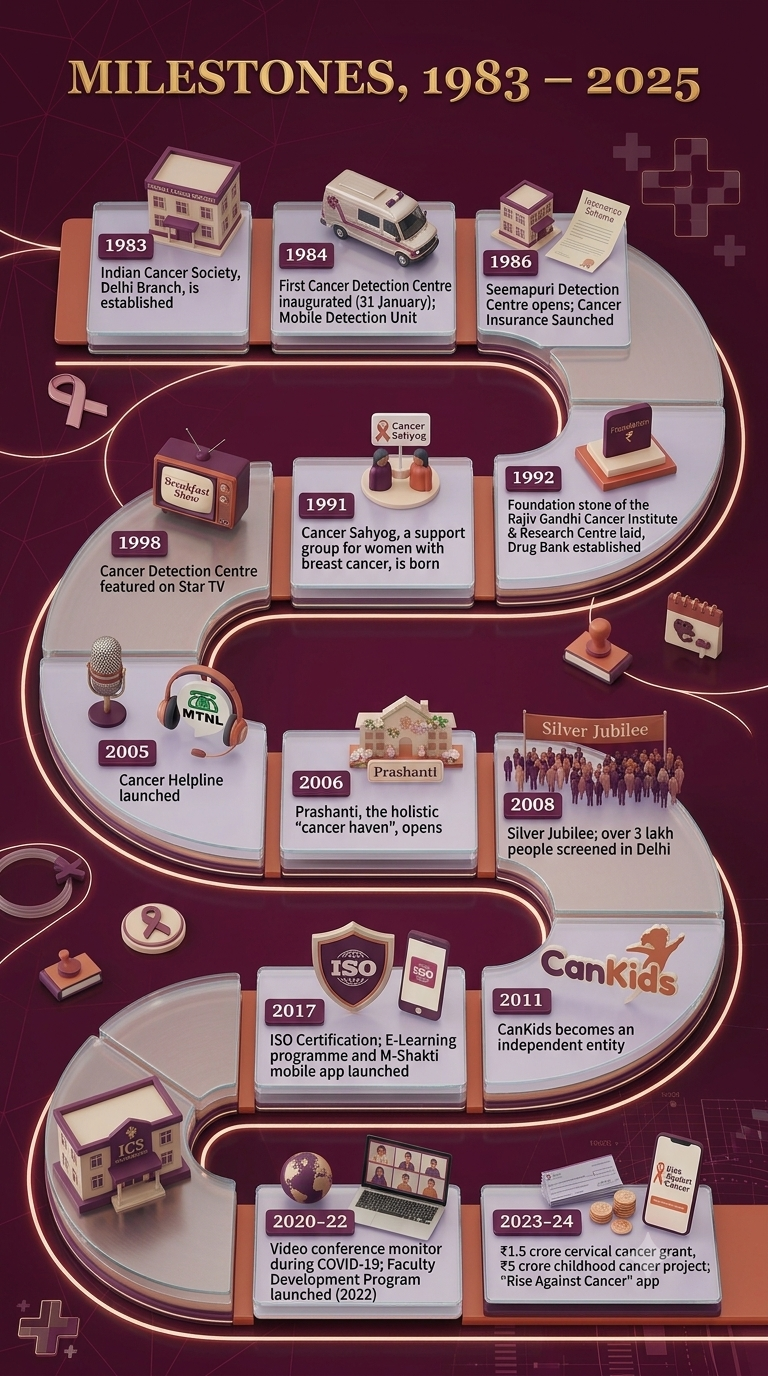
The momentum built quickly. By 1985, the mobile units, financed by various forward- thinking corporate houses, became a familiar and welcome sight. Fundraising, the lifeblood of this compassion, took creative forms. Funds were essential to keep the men and its machinery rolling. By 1986, the efforts were yielding profound results. Screening numbers surged, but the Society was counting more than numbers; it was saving lives. The services became more sophisticated with the introduction of in-house radiology and pathology facilities, meaning a patient could receive a comprehensive assessment under one caring roof. This year also saw a deeply impactful expansion: the opening of a Detection Centre in Seemapuri, funded by the shortlived lottery proceeds. This was a deliberate, compassionate strategy to serve the less affluent communities. The Seemapuri centre wasn’t just a building; it was a sanctuary of trust. In its very first year, it detected 135 pre- cancerous and 51 early cancer cases. Each number represents a life potentially saved, a family kept whole. This was the promise in action. In another pioneering move, the Cancer Insurance Scheme was launched. The management of Escorts Ltd., demonstrating remarkable corporate citizenship, enrolled all 633 of its employees. This was a novel safety net, acknowledging that the financial toxicity of cancer could be as devastating as the disease itself. It was an early recognition of the holistic nature of the crisis a cancer diagnosis brings.
Leadership Transition and Vision for a Hospital: A Dream Takes Shape
The late 1980s were a period of transition and soaring ambition. In 1988, as Prof. Ramalingaswami moved from Delhi, the stewardship was seamlessly passed to Mr. S.L. Khosla, Chairman of Indian Oil Corporation. The commitment to strong, compassionate leadership remained unbroken. The Prashant Vihar Detection Centre was inaugurated, extending the Society’s reach. Fundraising efforts became grander, like a memorable concert by the legendary duo Jagjit and Chitra Singh, which not only raised crucial funds but also elevated the Society’s profile, touching people through the universal language of music. Influential profiles lent their support the LG Delhi Air Marshal HK L Kapur, The Chief of Air Force Air Chief Marshal OP Mehra and for moral support to Mrs Sonia Gandhi. Beneath these activities, a grander vision was simmering. The volunteers and leaders, seeing the relentless flow of patients with advanced diseases, began dreaming of a permanent, comprehensive solution. The first serious discussions about establishing a full-fledged cancer hospital began. This was no small dream; it was an audacious goal for a volunteer-driven society. Yet, the belief was unwavering. On a parallel course, the Cancer Prevention and Education Programme was now in full swing, delivering an impressive 75 lectures that year, ensuring that the message of prevention walked hand-in-hand with the dream of cure. The passion for a hospital for that ‘cure’ was not to be lost.
Evolution and Consolidation: The Birth of Cancer Sahyog
The early 1990s brought both validation and difficult, pragmatic choices. The Prashant Vihar Centre was closed in 1990 as it proved not to be cost-effective. This decision, though tough, demonstrated the Society’s commitment to sustainable impact, ensuring that every rupee donated was used for maximum community benefit. Efforts were redirected with renewed focus. A pivotal, deeply human moment occurred in 1991. While screening volumes peaked, with over 6,500 new patients, the Society recognized a gap that machines and tests could not fill. The emotional and social devastation of cancer, particularly for women, was a silent epidemic. From this understanding, Cancer Sahyog was born. After all, only someone who had walked the path or an immediate caregiver could understand the trauma of a cancer patient and offers his Sahyog. Initiated by Harmala Gupta who had just returned from her cancer treatment in Canada, dr Poonam Chandra a Pathologist, Mrs Jyotsna Govil a care giver to her father Initially it was a support group for women with breast cancer, it was a revolutionary concept. It acknowledged that the battle was not just physical but fought in the realms of fear, loneliness, and stigma. Here, women could share their stories, their tears, and their strengths with others who truly understood. This was the Society’s heart growing larger, learning to heal the spirit alongside the body. The decade of relentless effort culminated in a moment of immense pride in 1992, the Society’s 10th anniversary. On April 25, the Union Home Minister, Shri S.B. Chavan, laid the foundation stone for the Rajiv Gandhi Cancer Institute and Research Centre (RGCI & RC). It was the ultimate validation—a dream born in a small office was now becoming a cornerstone of healthcare in North India. The parallel path of creating a treatment Facility meanwhile proceeded on its relentless path. The Society also established a Drug Bank ,ensuring that poverty would not prevent access to life-saving medicines. The branch was no longer just providing services; it was building an ecosystem of care.
PART II:
Deepening the Roots and
Expanding the Reach
(1996-2005)
Expanding Community Engagement: The Power of a Shared Story
As the RGCI&RC rose from the ground, the Society’s work evolved. The late 1990s marked an era where the human connection became the central theme. The awareness programme, which would later be formally christened Cancer Jagriti, expanded systematically. Mrs Jyotsna Govil, Mrs Sunita Gupta, Mrs Anjali Soni, Mrs Chandra Gulabani, Mrs Usha Mongia, Volunteers moved beyond Rotary Clubs to schools, colleges, and corporate houses, demystifying cancer with courage and clarity. In 1998, a feature on the Cancer Detection Centre aired on Star TV’s Breakfast Show. This media recognition was crucial; it catapulted the Society into mainstream consciousness, letting thousands know that a support system existed. Collaborations with premier institutes like AIIMS, IRCH, and the Army R&R Hospital became institutionalized, creating a robust web of care where patients could be seamlessly referred for specialized treatment. But the soul of the Society was Cancer Sahyog. What began as a small initiative blossomed into a powerful force of compassion. In 1999, a landmark event occurred: the first interactive session between Cancer Sahyog volunteers and patients at AIIMS. The room was filled with a unique empathy that only those who had walked the path could provide. Survivors, Mrs Usha Ohri, Mrs SnehPrabha Bansal and M/s Santosh Handa now volunteers, sat with newly diagnosed patients, holding their hands, sharing practical tips, and, most importantly, offering living proof that there is life after cancer. Their financial aid, a modest sum initially, grew tenfold, crossing ₹4 lakhs on patient support by 2001. This was not just money; it was a lifeline, a gesture of solidarity that said, “We are in this with you.” Providing locally manufactured prosthesis bra’s to every women undergoing mastectomy for a proper body image was remarkable. For privacy, old sarees were used as screens held up by these volunteers1
Innovations and Strategic Partnerships: A Focus on the Young
This period also saw the Society embrace holistic care in new ways. The concept of Prashanti was taking form—a sanctuary that recognised healing needed to address the mind and spirit alongside the body. It envisioned offering Reiki, yoga, and meditation, a novel concept in Indian healthcare at the time. Simultaneously, a special, tender focus on childhood cancer began spearheaded by Mrs Poonam Bagai and her team; started as CanKids , focusing on the unique plight of young patients and their families. The Society understood that a child’s fight was different. The sterile, frightening environment of a hospital waiting room was transformed. Volunteers ensured it was a place of engagement, with toys and activities. They provided not just financial aid for treatment, but also support for school fees, books, and uniforms—fighting for a childhood amidst the fight for survival. The simple joy of a Diwali party organized for these children and their families became a beacon of normalcy and joy in a difficult time. The Terry Fox Run, supported by the Canadian High Commission, became an annual symbol of solidarity, with participation growing to six major hospitals, uniting patients, doctors, and the community in a shared mission.
Pioneering New Initiatives: The Human Voice on the Airwaves
The year 2003 was a turning point. The Society’s voice found a new medium: the radio. Talks on Breast Cancer began on All India Radio’s ‘Women’s Hour,’ breaking new ground by reaching women directly in their homes, often the primary caregivers yet the most neglected in their own health. This was advocacy infused with empathy. ICS was invited to Rajya Sabha to advise on creation of COPTA and Tobacco laws as ICS had started focusing on tobacco control in the early years itself. World No Tobacco Day was celebrated not just with seminars, but with vibrant street plays in slums and poster competitions in schools, making the anti-tobacco message accessible and relatable. Mrs Jyotsna Govil pioneered these activities along with the Jagriti volunteers. The partnership with CanKids deepened, formalizing the care for children. It was a holistic embrace, acknowledging that a child’s illness affects the entire family. The Society’s role was to be the steady, supportive friend through the entire storm—from diagnosis, through treatment, and into rehabilitation.
Strengthening Patient and Public Support: A Lifeline is Launched
By 2005, the Society’s approach had matured into a comprehensive support system. The Mastectomy Association was merged into Cancer Sahyog, providing women with prostheses and specialized bras. This was not just about physical reconstruction; it was about restoring dignity and confidence. Recognizing the need for immediate, accessible information, the Society launched a Cancer Helpline with support from MTNL. This phone line became a literal lifeline—a calm, knowledgeable voice at the end of the line for the confused and fearful, often the first point of contact for someone grappling with a terrifying new reality. The volunteer force was formalized under the banner “Cancer Jagriti,” a team of trained individuals who delivered over 100 talks in a single year. And the dream of Prashanti, the holistic care centre, was in its final stages of planning after Mrs Renuka Prasad’s return from UK where she had visited the Breast cancer haven and seeing its operations felt its need at ICS .it was necessary to provide patients having /have had cancer treatment get access to complementary therapies that would help them come to terms with their problems; rehabilitate back into society by counselling them through. The initiation of a Bereavement unit was also thought of providing compassion, acknowledging that care must extend to those grieving a loss, closing the circle of support with grace.
PART III:
The Era of Growth and
Specialization
(2006-2015)
Formalizing Support and Expanding Services: The Opening of Prashanti
The period from 2006 onwards was marked by a greater focus on specialized, holistic care. In a significant endorsement, Union Agriculture Minister Shri Sharad Pawar, after his own experience with oral cancer, agreed to become the Society’s patron. His support was a powerful message of solidarity from a public figure, helping to further destigmatize the disease. The year 2006 saw the realization of a beautiful dream: The Lal Diwan Chand Trust opened its doors in their CP Office to accommodate & finance us. We need to thank Mr. Vishwanath Ji, Mr. S.K. Sahni, Mr. Rajendra Gupta and Mr. M.K. Gaur for the opening of Prashanti. This unique ‘cancer haven’ was a sanctuary away from the clinical hospital environment. Here, the air was filled with Vedic chants, the quiet focus of yoga, and the calming energy of Reiki and meditation. Prashanti acknowledged a profound truth: to heal a person, you must care for their spirit as much as their body. It was a gift of peace to patients and caregivers alike, a place to find strength for the journey ahead. Cancer Sahyog’s work continued to grow in depth and impact. Their “Think Pink” campaign raised awareness for breast cancer, and their financial aid touched the lives of 76 patients, with disbursements exceeding ₹10 lakhs. The first “Walk for Cancer” on Survivors Day was not just an event; it was a public celebration of resilience, a parade of hope through the city’s streets.
Celebrating a Silver Jubilee and New Partnerships: A Milestone of Impact
2008 marked the Silver Jubilee of the Delhi Branch. This was a moment to reflect on a staggering achievement: the screening of over 3 lakh (3,00,000) people in Delhi. Each number a story, a life touched. The celebrations were fitting—a “Fashion Fights Cancer” event with Lakme at the Taj Palace merged glamour with cause, attracting new audiences and donors. The branch’s work was becoming more sophisticated, with programs like one with Merck on the HPV vaccine showing a forward-thinking approach to prevention. Despite challenges like volunteer recruitment, the branch persevered, its resolve hardened by its mission. In 2009, an Exhaustive Training Manual was created, standardizing the message of hope and ensuring every volunteer was equipped to be an effective ambassador. Even MTNL phone bills began carrying the message, “Cancer is Curable if detected early,” a quiet, constant reminder in thousands of homes.
“Cancer is Curable if detected early.”
Targeted Programs and Strategic Alliances: Caring for the Elderly and Forming National Bonds
The Society’s empathy extended to all sections of society. In 2010, a new project supported by HelpAge India brought tailored screening and awareness to the elderly, a often-neglected demographic. The introduction of the HPV/DNA cervical screening test a WHO Gold Standard represented a commitment to adopting the latest medical advancements for the benefit of the community. A significant evolution occurred in 2011 when CanKids, which the Society had nurtured from its infancy, became an independent entity. This was not a separation but a graduation—a testament to the Society’s role as an incubator of hope. The collaborative spirit remains strong. 2012 was a year of powerful alliances. A major partnership was formed with the Yuvraj Singh Foundation’s YouWeCan initiative, with ICS serving as a knowledge partner. Yuvraj Singh’s own public battle with cancer brought a wave of inspiration, and this partnership combined celebrity influence with the Society’s deep-rooted expertise. So, now ICS had supported the setup of 3 major Cancer Organisations, Can Support, CanKids and YouWeCan that were providing valuable support to anyone and everyone who faces cancer and supported them. In a wonderfully creative outreach effort, a partnership with the Auto Drivers Union placed ICS stickers on auto-rickshaws, turning thousands of these ubiquitous vehicles into mobile billboards of hope, carrying the message through every lane and alley of the city. Talks for DTC Bus Conductors at the Depots were initiated by Mrs, Sneh Kapur.
Sustained Growth and Impact: The Rhythm of Compassion
From 2013 to 2015, the Society’s work continued its robust, rhythmic growth. “Artistes against Cancer” and “Drive against Cancer” Charity Golf initiatives added a new dimension to fund raising over 37 lakhs in 2015. Awareness through walks and Cyclothon attracted crowds who were now learning about cancer control through its sign and symptoms / screening to enable to early diagnosis for a life thereafter. It was Mrs Rashmi Vohra who brought the concept of Walks through her interaction while in America with her husband. Mrs Indra Jasuja helped with the first cyclothon in Gurgaon getting school children to participate in the Kingdom of Dreams. These fund raisers were a clear indicator of the growing need and the Society’s unwavering commitment to raising funds for patient support. Awareness talks expanded to incredibly diverse groups—from DTC staff to wives of defence personnel—leaving no segment of society untouched by the message of early detection.
PART IV:
Modernization and Innovation
(2016-2025)
Pioneering Digital and Holistic Solutions: The Age of Empowerment
The years after 2015 were defined by embracing technology to amplify compassion. The Society’s reputation now extended globally. It was awarded the “All of Me” project by the American Cancer Society to promote wellness in workplaces, a sign of its standing on the world stage. In 2017, the branch achieved ISO Certification, a formal recognition of its operational excellence and credibility as the Creditability Alliance—important for the trust of donors and partners. The same year, an E-Learning programme was launched, and the innovative M-Shakti mobile app was developed, putting a wealth of reliable cancer information directly into the hands of the public. This was the modern evolution of the movie hall slide—a digital tool for empowerment. The Child Nutrition program received a major boost from Abbott India and the Essel Social Welfare Foundation and Cipla Foundation, addressing a critical need for children weakened by chemotherapy. Every initiative was a thread in a vast safety net.
Adapting to New Realities: The Unbroken Spirit During COVID-19
The period from 2020 to 2022 was dominated by the COVID-19 pandemic, which posed an unprecedented challenge. Physical camps, the Society’s lifeblood for 36 years, had to be paused. But the mission was too important to stop. The Society’s spirit proved unbreakable. In a remarkable pivot, awareness went virtual. Talks, training programs, and even the annual “Artistes Against Cancer” concert, featuring the iconic Usha Uthup in 2021, were streamed into homes. The Society seized the opportunity to conduct training for 25 cancer activists from Sri Lanka, demonstrating its thought leadership and sharing its model of compassion across borders. The Faculty Development Program (FDP) was launched in 2022, aiming to create a national network of cancer educators. Even in lockdown, the Society found a way to grow, to reach out, to ensure that isolation did not compound the fear of a cancer diagnosis.
The Path to the 75th Anniversary: A National Force for Good
The period from 2023-2024 witnessed a powerful surge, a robust post-pandemic recovery that proved the resilience of the Society’s model. Its reach became truly national. The FDP under Mrs Govil’s stewardship and conducted by Mrs Aruna Ummat expanded its outreach to 21 states, creating a multiplier effect of knowledge. The “Swayam” online Self Learning Programme on a GOI Platform conducted by seventeen oncologist educated over 18,000 individuals. A new, patient-centric mobile app, “Rise Against Cancer,” was launched in five languages, ensuring no one was excluded by a language barrier. Internationally, our connections with Cancer organisations have increased. Led by Mrs Jyotsna Govil, Mrs Sunita Gupta, Renuka Prasad and others have done an Advanced Training Course with them. Mrs Govil and Mrs Sunita Gupta attended the APCASOT in Brisbane; Rekha Gulabani as a pioneer in Metastatic Breast Cancer attended the Global ABC Cancers’ conference was actively engaged with them; Indra Jasuja and her team have excelled in Palliative care while many other volunteers have brought glory to ICS with their various activities. The scale of impact reached new heights. The Society secured its largest-ever grant, ₹1.5 crore, for cervical cancer elimination, and a ₹5 crore project for childhood cancer treatment. Partnerships with pharma giants like the Roche, Cipla Foundation and Lumax Charitable Foundation and many others were solidified, a testament to the trust the corporate world had in the Society’s ability to deliver change. Most tellingly, the Society’s influence now extended to the highest levels of policy. It was called upon by the Rajya Sabha to consult on making cancer drugs affordable. The Society had evolved from a service provider to a key opinion leader, shaping the very future of cancer care in India. It continued to innovate with deeply empathetic initiatives, such as providing ocular prostheses for children who had survived retinoblastoma—restoring not just a face, but a future. The Ministry of Health and Family Welfare turned to us on guidance for the mandated setting up of 100 Day Care Centres for the convenience of Cancer patients chemotherapy treatment in the 2025 Budget allocations. ICS was the only NGO to be invited.
CONCLUSION:
The Enduring Legacy –
From a Delhi Branch to a National Force
The history of the Indian Cancer Society, Delhi Branch, is a story of thematic evolution. The awareness talk delivered in a community hall in 1990 and the FDP session streamed nationwide in 2024 are part of the same continuum. The mobile van of 1984 and the ‘Rise Against Cancer’ app of 2024 serve the same life-saving purpose of early detection. The financial aid given to a single patient in 1991 and the multi-crore grants for cervical and childhood cancer in 2024 are expressions of the same unwavering compassion. As it approaches its 75th year, the Society is no longer just a branch of an organization; it is a thought leader, consulted by the government on policy, a pioneer in digital health education, and a beacon of holistic care. Its legacy is etched in every life touched, every early detection made, and every patient supported through their most challenging time. The themes of its past have laid a formidable foundation for the future, ensuring that for the next 75 years, its work of bridging the gap between the reality of cancer and the hope for a cure will continue with even greater vigour and vision. As the Indian Cancer Society, Delhi Branch, looks toward its 75th year in 2024-25, it does so as a mature, influential, and deeply compassionate organization. The mobile van of 1984 now lives on in a mobile app, but the core mission remains unchanged: to ensure that no one faces cancer alone. From a small office with a big dream, the ICS Delhi Branch has built an enduring legacy of hope. It is a legacy written in the courage of survivors, the dedication of volunteers, the generosity of donors, and the quiet, unwavering belief that behind every statistic is a life worth fighting for. The story is far from over; the next chapter promises to bring hope even closer to those who need it most.
