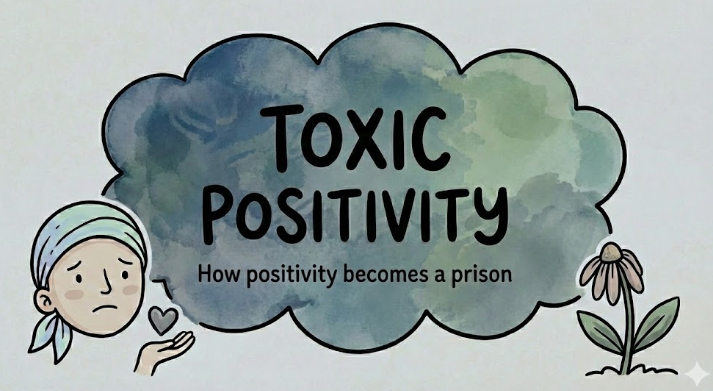
Positivity is often seen as a solution to everything. From social media posts to everyday conversations, we are constantly told that staying positive can fix even the toughest situations. However, when it comes to serious illnesses like cancer, this idea can sometimes turn harmful. This is where the concept of toxic positivity comes in — the pressure to stay happy and hopeful even when someone is suffering deeply.
Cancer is not just a physical illness. It affects a person emotionally, mentally, and socially. Patients experience fear, pain, uncertainty, anger, and exhaustion. Yet, instead of being allowed to feel these emotions, they are often told things like “stay strong,” “don’t think negative,” or “everything will be fine.” While these statements may come from a place of concern, they often ignore what the patient is actually going through.
Why do you think toxic positivity is especially harmful for cancer patients?
Responding to this, Anchal Sharma explained that toxic positivity makes negative emotions seem unacceptable. She shared that when patients are constantly pushed to be positive, they feel pressured to hide their pain just to make others comfortable. “When positivity is forced on cancer patients, it makes them feel like their fear or sadness is wrong,” she said. Instead of feeling supported, patients may feel emotionally misunderstood and isolated.
This emotional isolation can lead patients to stop sharing their true feelings and pretend they are okay, even when they are struggling deeply.
We often hear phrases like ‘everything happens for a reason.’ How do such statements affect patients?
Anchal pointed out that toxic positivity also appears in everyday language. Common phrases like “everything happens for a reason” or “others have it worse” may sound comforting, but they often shut down meaningful conversations. “These statements stop patients from expressing what they are actually going through,” Anchal said. Rather than helping, such remarks can make patients feel guilty for feeling low or scared during their journey.
So what kind of support do cancer patients actually need?
According to Anchal, what cancer patients truly need is empathy, not motivation. They need people who can listen without trying to fix their emotions or offer constant advice. “Sometimes, just saying ‘I understand this is hard’ matters more than giving hope-filled advice,” she shared. Allowing patients to talk freely about their fears helps them feel heard and less alone.
From a broader perspective, the discussion made it clear that positivity is not bad — but it should never be compulsory. It is completely normal for cancer patients to have bad days. Feeling sad or scared does not mean they are weak or giving up. Healing is not only about medical treatment; it also involves emotional acceptance.
In the end, moving away from toxic positivity means choosing kindness over comfort and understanding over quick reassurance. By creating space for honest emotions, we can support cancer patients in a way that feels real, respectful, and truly human.
By Unnati Saxena Initiative by Group Imagination Unleashed
People often think that healing from an illness or an injury only happens with the help of medicine and treatments, but hope also plays a pivotal role in the healing process.
Hope is a very interesting word. For some it’s simply that, a word, but for some, it’s something that gives them reason to get up in the morning. Everyone says that having hope heals is, it keeps us alive and it keeps us wishing for something more, which ultimately leads us to working for that something.
Many however question whether hope truly helps us heal. The answer to that is yes. Hope is something that helps us heal some of the most traumatising and deep wounds. Both physical and mental. Hope is not just thinking positively or staying happy. Hope is believing that you will heal and that things will get better. Hope is believing that it will always get better. People tend to get discouraged and sad when they or people they love get injured or suffer from an illness, but it is extremely important that they believe and that they hold onto hope. This is not only to feel better, but having hope can actually hasten the healing process.
If someone keeps having hope, their healing process becomes better, maybe not by an astonishing degree, but by a good degree nonetheless. Having hope strengthens a person’s will and their motivation to heal quicker.
The Medical Aspect
Beyond the psychological aspect, hope is medically proven to heal people quicker. Our brain, when it’s not at war with emotions or doesn’t feel desolate, tends to work much better and more efficiently. When a person feels hopeful and positive, endorphins and enkephalins are released in their brains. This helps lessen the pain and subsequently the medicines. In addition to that, cortisol, which is the stress hormone, also gets lowered when someone feels hopeful and positive. This helps people lessen their stress levels which are known inhibitors of the healing process, thus catalysing the process and quickening the process.
The most interesting yet simple thing hope can help achieve is the placebo effect. Placebo effect is when someone believes a certain thing, often untrue and their body starts behaving in the manner. When a person who has hope starts believing that they’re healing and they’re getting better, their body starts responding accordingly. The placebo effect has been tested multiple times and is known to work for many cases. It means having a hopeful mindset can quicken your body healing by a large percentage.
The Caregivers
One thing that many people seem to ignore or not pay enough attention to, are the caregivers. Whilst it is imperative for the patients themselves to hold on to hope, the caregivers should not feel demotivated either. The caregivers cannot feel the medical benefit of having hope, but the psychological benefits more than make up for that.
The caregivers, when they are hopeful, are of the more help to the patient to heal. A positive and motivated atmosphere is an integral part of healing and is non-negotiable. The caregivers do feel exhausted and sad, sometimes even more than the patient, and that is completely fine. One shouldn’t suppress their emotions but should rather express them and deal with them in order to feel happy and healthy again.
Mind and body
The mind and body are one. Whilst one works, the other complements it. The brain needs to be at a good place for the body to do its job and that’s exactly what hope helps us with. Hope doesn’t have to be something big, some grand gesture or declaration. Hope can be simple day to day activities. Hope can be waking up and going about your day exactly like you would believing that you will heal soon. It can be not changing your bonds, and calling people when you feel like talking.
People don’t have to figure things out by themselves. They can reach out to people and people who aren’t suffering from injuries or illnesses can be the people that can help others find hope and happiness. For most people hope isn’t the big things, it’s the little things that make them feel happy and powerful. That’s what hope is and that’s what helps people heal quicker and in a more holistic way. Having hope does help, and it makes life just that much easier.
By Riya Dubey Initiative by Group Imagination Unleashed
Cancer. One word enough to scare even the most fearless person.
There are moments in life when things feel too scary to make sense of or talk to someone about.
When advice feels heavy and the burden to stay strong feels overwhelming.
And in those moments, what helps most is not answers. It is presence.
In Hindi, Kiran means a ray of light. A light of hope that finds its way through even the smallest opening during difficult moments.
Not a spotlight. Not something overwhelming. Just a small, steady glow that reminds you that you are not alone.
That is where we found our Kiran.
Why We Chose the Name Kiran
Cancer is often spoken in terms of medical treatment plans, reports, numbers and outcomes. All of this truly matters, but the emotional side is mostly neglected and overlooked.
The silence. The fear. The exhaustion. The days when hope feels strong, and the days when it feels impossible to hold on to.
Kiran was born from the understanding that healing is not only medical. It is emotional. It is human.
We chose the name Kiran because it represents something gentle. Something realistic. Something that does not demand positivity or strength. Just presence.
What is Emotional Support During Cancer When Words Feel Heavy
A person who listens without trying to fix. A moment of comfort without questions. A space where it is okay to feel tired.
A place where everyone is recognised from patients, caregivers, survivors and healthcare providers.
Kiran Really Stands For
Kiran is not a person. Kiran is not a programme.
Kiran is about being there.
It is about emotional support during cancer care. It is about acknowledging that mental health matters just as much as physical health. It is about creating conversations around feelings that people often hide because they do not want to seem weak.
At Indian Cancer Society, Kiran represents our focus on psycho-oncology. This is the aspect of cancer care that looks at the emotional, psychological, and social impact of the illness on patients, caregivers, families, and even healthcare professionals.
There are moments during a cancer journey when questions feel heavy.
Not medical questions. But emotional ones.
Questions like: Is it okay to feel this tired? Why does hope feel so hard today? Who do I talk to when I don’t want to worry my family?
Kiran exists for those moments too.
As part of this initiative, the Indian Cancer Society is introducing Kiran, a gentle conversational space on its website where people can ask questions, share what they’re feeling, or simply start a conversation when they don’t know where to begin.
This space is not about giving perfect answers. It is about offering emotional support during cancer, without judgement or pressure.
For some, it may just be a place to ask a small question. For others, it may become a way to connect with the Indian Cancer Society and speak to someone when they feel ready.
Because mental health in cancer care matters. And sometimes, emotional support begins with knowing that help is accessible.
Kiran is meant to be that first step. Quiet. Supportive. Always there.
When Hope Feels Heavy
We often tell people going through cancer to “stay positive.” It comes from a good place. But sometimes, it adds pressure.
What happens when someone does not feel hopeful? What happens when fear feels louder than faith? What happens when exhaustion takes over?
Kiran exists to say this clearly. It is okay to not feel okay.
Hope does not always look like smiling. Sometimes, hope looks like rest. Sometimes, hope looks like crying without apology. Sometimes, hope looks like saying, “I cannot do this alone.”
According to studies highlighted in the Oncology Nurse Advisor Report, social support has a positive effect on cancer patients’ physical health, emotional wellbeing and overall quality of life.
Through Kiran, we want to normalise these emotions. We want patients and caregivers to know that vulnerability is not weakness. It is honesty.
The Emotional Side of Cancer Care
Cancer care often focuses on treatment, which is necessary and life-saving. But emotional wellbeing is just as important.
Patients may struggle with fear, anxiety, body image issues and loss of control. Caregivers may feel guilt, burnout and constant emotional fatigue. Families may not know what to say or how to behave.
Even healthcare professionals are not immune. Witnessing illness every day can take an emotional toll.
Kiran opens space for these conversations. Through workshops, podcasts, blogs, community activities and storytelling, the initiative focuses on how people can support each other better.
Not through big gestures. But through small, thoughtful ones.
#BeSomeonesKiran
The hashtag #BeSomeonesKiran is an invitation.
It does not ask you to fix someone’s pain. It does not ask you to have the right words. It simply asks you to show up.
You can be someone’s Kiran by listening without interrupting. By sitting quietly when words feel unnecessary. By checking in, even when you do not know what to say. By respecting silence instead of filling it with advice.
Being someone’s Kiran does not require expertise. It requires empathy.
Small Acts Matter More Than We Think
Often, people hesitate because they fear saying the wrong thing. So they say nothing.
Kiran challenges that silence.
Sometimes, a message that says “I am here” is enough. Sometimes, sharing a meal matters more than giving advice. Sometimes, acknowledging someone’s pain without trying to minimise it brings comfort.
Through Kiran, we want to remind people that emotional safety is healing. When people feel understood, supported, and accepted, it lightens the weight they carry.
A Community-Led Movement
Kiran is not meant to exist only online or within organisations. It is meant to live in conversations. In homes. In hospitals. In communities.
This initiative brings together survivors, caregivers, mental health professionals, doctors, volunteers, and everyday people. Each voice adds to the collective understanding of what compassionate care truly looks like.
The goal is simple. To make cancer care more human.
A Gentle Reminder
Kiran is not about constant light. It is about light that appears when things feel darkest.
You do not have to be strong every day. You do not have to be hopeful all the time. You just have to know that support exists.
And sometimes, you might be that support for someone else.
So today, if you can, pause and ask yourself a simple question. Who can I be a Kiran for?
Because even the smallest light can change how a journey feels.
#BeSomeonesKiran
Before you move on, pause for a moment and think about this. Who has been your Kiran?
It might be someone who checked in when you didn’t know how to ask for help. Someone who stayed, even in silence. Someone whose presence made things feel a little less heavy.
If you feel like sharing, you can tell us about them on Instagram. Use #BeSomeonesKiran and tag the Indian Cancer Society. Sometimes, stories help others feel less alone.
If you’re looking for support or want to understand this journey better, the Indian Cancer Society app brings together information, resources and guidance around cancer care, including emotional wellbeing. It’s there when you need it.
And if nothing else, carry this thought with you. You don’t have to fix anyone’s pain. You don’t have to have all the answers.
Just being there can be enough.
Be someone’s Kiran.
By Sonakshi Arora Initiative by Group Imagination Unleashed