A complete guide to warning signs, cervical cancer, the HPV vaccine and why early action saves lives.
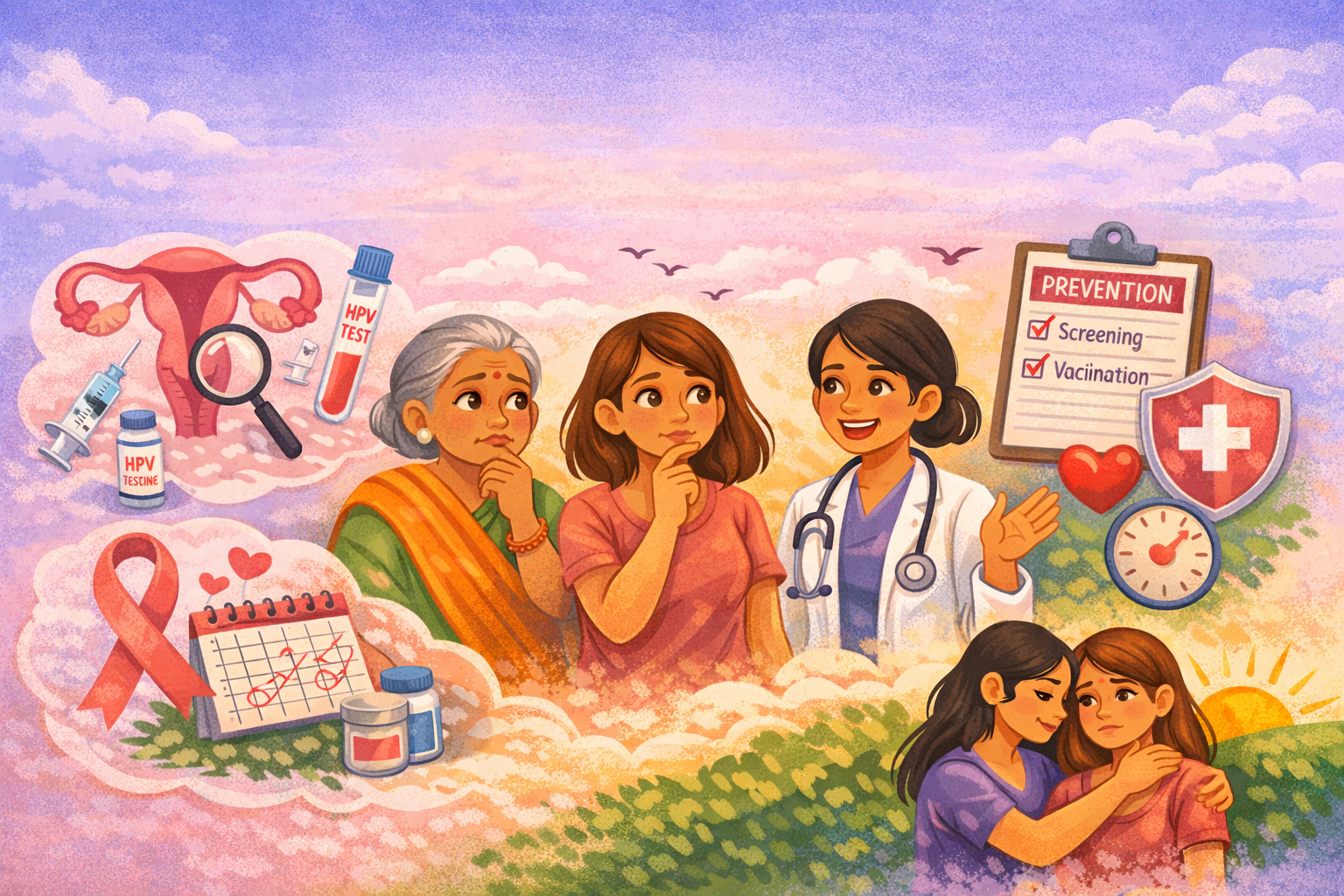
Featuring insights from Dr. Sunita Wadhwa, Cancer Detection Centre
Here is a number that should stop us in our tracks. India accounts for nearly a quarter of all cervical cancer deaths in the world. Cervical cancer is the second most common cancer among Indian women. And yet, it is one of the most preventable cancers we know of. There is a vaccine. There are screening tests. There are clear warning signs that the body gives us.
So why are so many women still dying from it?
We sat down with Dr. Sunita Wadhwa from the Cancer Detection Centre, who works actively on women’s health and cancer prevention, to get some clear answers. What she shared is something every woman in India needs to hear.
The honest answer is a mix of things: lack of awareness, stigma around women’s health, fear of what the results might show and a healthcare system that has not always made it easy for women to put themselves first. Cervical cancer is not the only one either. Breast cancer, uterine cancer and other cancers affecting women often go undetected for the same reasons.
This blog is about changing that, one conversation at a time.
What Even Are Gynaecological Cancers?
Gynaecological cancers are cancers that affect the female reproductive system. According to Dr. Wadhwa, the most common among Indian women are cervical cancer, uterine cancer and breast cancer. These cancers develop when normal cell growth goes wrong, triggered by a combination of genetic factors and environmental changes.
When it comes to cervical cancer specifically, the risk factors are more concrete than most people realise. Genetics play a role: if a mother or elder sister has had cervical cancer, the risk goes up. But lifestyle and environmental factors carry significant weight too. Smoking, early sexual activity, multiple partners, unprotected sex and multiparity (having many children) are all factors that increase a woman’s chances.
Knowing your risk is the first step. Acting on it is the next one.
Your Body Is Giving You Signals. Are You Listening?
Ask any woman why she put off going to the doctor and the answer is usually some version of: I thought it was nothing. I was too busy. It went away after a while.
Dr. Wadhwa has seen this pattern repeatedly and she is direct about it.
“Abnormal bleeding, bleeding in between the periods, abnormal pattern of bleeding, bleeding after intercourse, too much bleeding, watery discharge, blood discharge, foul-smelling discharge. These are all early symptoms which truly women in India ignore if they are not aware.”
— Dr. Sunita Wadhwa, Cancer Detection Centre
Here are the early warning signs no woman should dismiss:
- Unusual bleeding: Between periods, after sex or any bleeding after menopause. None of this is normal and all of it needs medical attention.
- Unusual discharge: A change in colour, smell or consistency, especially if it is watery, blood-tinged or foul-smelling.
- Persistent lower abdominal pain: Pain without an obvious reason that keeps coming back.
- Loss of appetite, fatigue and general muscle wasting: When the body is fighting something, it often signals through exhaustion and unexplained changes.
- A lump in the breast or armpit: Not every lump is cancer, but every lump deserves a doctor’s assessment.
The rule is simple: if something feels off and it has been there for more than two to three weeks, please see a doctor. You know your body better than anyone else does.
Cervical Cancer Is 100% Preventable. Yes, Really.
This is not a motivational statement. It is a medical fact and Dr. Wadhwa says it plainly.
“If we treat the abnormal findings at that stage itself, cancer will not happen at all. It is a 100% preventable cancer, cervical cancer.”
— Dr. Sunita Wadhwa, Cancer Detection Centre
Cervical cancer develops from HPV, the Human Papillomavirus. HPV is extremely common and most people’s bodies clear it on their own. But in some women, certain high-risk strains persist and, over time, cause pre-cancerous changes in the cervix. The key word here is time. Those changes do not become cancer overnight. And that window is exactly where screening and vaccination come in.
Pap Smear and HPV DNA Testing: Simpler Than You Think
One of the most common reasons women avoid cervical screening is fear. Fear of the procedure itself, fear of what might be found and in many cases, myths about what these tests actually involve.
Dr. Wadhwa addresses this directly.
“It is a simple procedure. No invasive procedure, no cutting. Just with a wooden spatula we take the smear or for HPV DNA we use a brush which is non-harmful. Without anaesthesia we do it, nothing happens. If the patient is explained properly, she will readily agree for this test.”
— Dr. Sunita Wadhwa, Cancer Detection Centre
Here is what the screening schedule looks like:
- Start Pap smears from age 21 to 25, done every 2 to 3 years if results are normal.
- HPV DNA testing every 5 years if normal.
- After age 50, annual screening is recommended.
- If any abnormality is found, it can be treated immediately with simple procedures like colposcopy, thermal ablation or LEEP, well before cancer develops.
It is five minutes that could change everything.
The HPV Vaccine: Get It Before You Need to Think About It
The HPV vaccine is one of the most powerful tools we have against cervical cancer and it is widely underused in India. Dr. Wadhwa is clear about who should get it and when.
“HPV vaccine is very important. It should be given to girls before they start their sexual activities. We recommend it at the age of 9 to 15. It can be given up to the age of 45, but the best results are when you give it before the start of sexual activity.”
— Dr. Sunita Wadhwa, Cancer Detection Centre
A few things worth knowing about the HPV vaccine:
- It protects against the HPV strains most commonly responsible for cervical cancer.
- It is available in India. The nine-valent version covers more strains and offers broader protection.
- It does not give 100% protection against every strain, but it significantly reduces risk.
- Even if you have been vaccinated, continue with regular Pap smear and HPV DNA screening. The vaccine and screening work together, not instead of each other.
- Women up to age 45 can still benefit. Speak to your gynaecologist about whether it makes sense for you.
It Is Not Just Cervical Cancer: The Bigger Picture
Cervical cancer gets a lot of attention in this conversation and rightly so. But the picture is broader. Breast cancer has now overtaken cervical cancer as the most common cancer among Indian women in urban areas. Uterine cancer is also on the rise.
What ties all of them together is the same truth: early detection dramatically improves survival. A woman diagnosed with breast cancer at Stage 1 has a survival rate of over 90%. At Stage 4, that number drops sharply. The difference, more often than not, comes down to whether she got checked.
Dr. Wadhwa’s advice on lifestyle is practical and straightforward:
“You should be physically active. If you are smoking, stop smoking. Eat healthy foods, vegetables, a healthy balanced diet. Avoid alcohol. Build up your immune system. Patients with a weak immune system are more prone to cancer-like diseases.”
— Dr. Sunita Wadhwa, Cancer Detection Centre
No miracle diets, no expensive supplements. Stay active, eat in moderation, do not smoke and go for your screenings. That is genuinely most of it.
The Part Nobody Talks About: The Emotional Weight
Ask any woman why she has been putting off her screening and chances are the answer is not just about time or access. A lot of it is fear. Fear of what the results might say. Fear of disrupting the family. Fear of being a burden.
And once a diagnosis comes, the emotional impact does not get smaller. It grows. The anxiety, the uncertainty, the loneliness of not knowing who to talk to or how to ask for help.
Dr. Wadhwa has seen firsthand what a difference support makes in outcomes.
“Mental health and emotional support is very important. Family support, support by caregivers and mental health professionals, they are very important in guiding the patient. I have seen a patient, 86 years old, coming out of breast cancer very well because she had a very strong family to support her.”
— Dr. Sunita Wadhwa, Cancer Detection Centre
Eighty-six years old. Coming out of breast cancer. Because of family.
That is what emotional support looks like in practice. It is not a soft extra. It is part of the treatment.
This is exactly why the Indian Cancer Society Delhi created the Kiran Campaign.
Meet Kiran: Because Healing the Body Starts With Healing the Mind
Kiran is the Indian Cancer Society Delhi’s awareness campaign built around one simple but powerful belief: that emotional support is not a luxury in cancer care. It is a necessity.
Running under the tagline ‘Healing the unseen side of cancer,’ the campaign was created to normalise conversations around the psychological impact of cancer, whether you are a patient, a survivor or a caregiver quietly holding everything together. It is built on the belief that nobody should have to navigate any part of this alone.
Kiran is also a 24/7 AI-powered chatbot available on the Indian Cancer Society Delhi website. You can talk to Kiran any time you have a question about cancer support resources, ICS services or the Rise Against Cancer app. No appointments, no waiting. Just a steady, helpful presence whenever you need it.
Dr. Wadhwa herself pointed to digital tools as an important resource, noting that the Rise Against Cancer app gives patients access to all the information they need and that volunteers connected to ICS who have already been through cancer can help guide others through their journeys too.
The #BeSomeonesKiran movement asks all of us to think about who in our lives might need that nudge, that kind word, that gentle push to go get checked. Sometimes being someone’s kiran, their ray of hope, looks like forwarding them this blog. Or sitting with them at their appointment. Or simply saying: you are not overreacting. Go find out.
Because the women who get screened, who get vaccinated, who act on their warning signs early: they do not just save their own lives. They stay present for everyone who loves them.
What You Can Do Right Now
You do not need to do everything at once. Start with one thing.
- Book a Pap smear if you have not had one in the last 3 years.
- Ask your doctor about the HPV vaccine at your next visit.
- Do a breast self-examination this week and make it a monthly habit.
- Download the Rise Against Cancer app for guidance, support resources and more.
- Talk to Kiran on indiancancersocietydelhi.in if you have questions and are not sure where to start.
- Share this blog with one woman in your life who needs to hear it.
Preventable cancer only gets prevented when we act. And acting starts with knowing.
Now you know. So does someone you love.
Want to Hear More?
Listen to the full conversation with Dr. Sunita Wadhwa on the Indian Cancer Society’s podcast: https://youtu.be/3RwVt4kd2Ro
This article is based on an interview with Dr. Sunita Wadhwa, Gynaecologist, Cancer Detection Centre, conducted as part of the Indian Cancer Society’s Kiran Initiative
For cancer support, screening information and resources, visit indiancancersocietydelhi.in or download the Rise Against Cancer app.
By Sonakshi Arora
Initiative by Group Imagination Unleashed