A cancer survivor, honorary secretary of the Indian Cancer Society Delhi, shares what nobody tells you about the emotional side of cancer.
When someone in your family gets diagnosed with cancer, the first few hours are a blur. There is the doctor’s voice, the medical terms, the paperwork. And then there is the drive home, where nobody says anything and everyone is thinking the same thing: what happens now? how to cope with cancer diagnosis?
Most conversations about cancer focus on treatment. Which hospital, which doctor, which therapy. And those conversations matter enormously. But there is a whole other part of this journey that rarely gets talked about: the fear, the grief, the isolation, the financial panic, the toll it takes on marriages and children and the person quietly holding it all together at home.
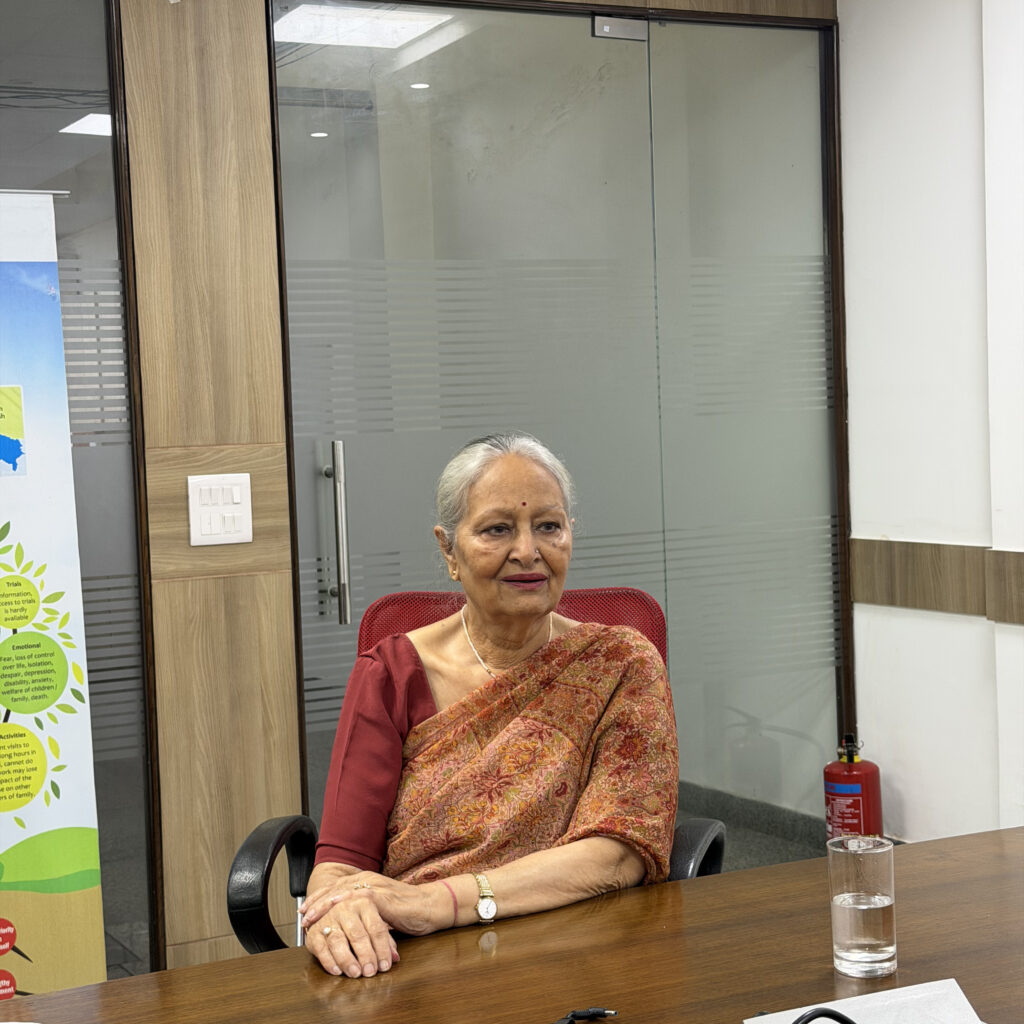
Mrs. Renuka Prasad knows both sides of this. She is a breast cancer survivor, diagnosed in 1997 and has spent nearly three decades since then working with the Indian Cancer Society Delhi to make sure no patient or caregiver has to face the emotional side of cancer alone. She is also the Honorary Secretary of ICS Delhi.
What she shared is honest, warm and deeply necessary.
‘The Day I Saw My Scar, I Felt Like My World Had Ended’
Mrs. Prasad does not speak about her cancer diagnosis from a distance. She speaks about it the way someone does when they have lived every moment of it.
She was a socially active woman, deeply involved in her community through the Army Wives Welfare Association, when she was diagnosed with breast cancer and underwent a full mastectomy. The morning she first saw her scar, she felt, in her own words, like her world had ended.
“When I saw that scar for the first time, I felt like how will I go out and face society now? My body felt asymmetrical. I was a very socially active woman and I thought, my life is over.” — Mrs. Renuka Prasad, Honorary Secretary, Indian Cancer Society Delhi Branch
What changed things was not more medical information. It was a person. Someone from the Indian Cancer Society’s Cancer Sahyog unit came to see her, sat with her and told her about breast prosthesis, a simple thing that most women are never told about after a mastectomy. One conversation. One piece of information. And her smile came back.
“That one thing brought the smile back on my face. And I thought, if I can live like this and encourage others, why not? At that moment I felt God was waking something inside me: you have done enough other work, now get up and do something for others.” — Mrs. Renuka Prasad, Honorary Secretary, Indian Cancer Society Delhi Branch
She has been doing exactly that since 1998.
What Is Psycho-Oncology and Why Does It Matter?
Psycho-oncology is a field that addresses the psychological, emotional, social and behavioural aspects of cancer, for both patients and their families. In simple terms, it is the recognition that cancer does not just affect the body. It affects the mind, the relationships, the identity, the sense of future.
In India, this field is still finding its footing. Most cancer care focuses heavily on the clinical side and rightly so. But Mrs. Prasad has watched what happens when the emotional side gets left behind.
“It is not just the patient. If a woman is sick at home, the whole support system collapses. Who will send the children to school? Who will cook? And on top of that she is worrying about whether her children are being stigmatised at school, whether her husband sees her as a person or just a burden. These emotional drains are very real.” — Mrs. Renuka Prasad, Honorary Secretary, Indian Cancer Society Delhi Branch
The financial weight compounds everything. New therapies like immunotherapy and CAR-T therapy offer real hope but cost lakhs, sometimes crores. Families take on debt, sell assets and exhaust savings, all while trying to show up strong for the person going through treatment.
And then there is the stigma. The neighbour who stops sending food because she worries cancer might be contagious. The relative who quietly distances themselves. The children who come home from school having been told to stay away from their classmates.
“Cancer is not a chhua-chhoot ki bimari(infectious). It does not spread from person to person. But stigma isolates families at the exact moment they need community most.” — Mrs. Renuka Prasad, Honorary Secretary, Indian Cancer Society Delhi Branch
Caregivers Carry More Than Anyone Sees
If patients are the most visible part of the cancer journey, caregivers are the most invisible. They are the ones who wake up at 3am, who drive to every appointment, who manage the medicines and the meals and the emotions of everyone around them, all while quietly suppressing their own.
Mrs. Prasad talks about caregivers with a particular tenderness.
“The caregiver is a very different kind of person. They hold back their own grief and sadness to give strength to the one they are caring for. And the closer that relationship is, the harder it is. It is a very sacred relationship.” — Mrs. Renuka Prasad, Honorary Secretary, Indian Cancer Society Delhi Branch
What caregivers need, she says, is not just practical guidance but a shift in how they are counselled. Too often, well-meaning people treat the patient as fragile, as someone to be pitied. This, she argues, does the opposite of helping.
“Do not say, ‘Oh poor you, how will you manage?’ That destroys their self-confidence. And you are also breaking the family. The right message to a caregiver is: walk with them confidently. Your strength becomes their strength.” — Mrs. Renuka Prasad, Honorary Secretary, Indian Cancer Society Delhi Branch
She also has direct advice for patients and families about toxic people in their lives: set boundaries without guilt. Not everyone who visits means well. Some people, even within families, bring discouragement instead of support. Politely, firmly, limit those interactions.
“Stay away from toxic people. Close the door for them. Just hello, how are you, finished. Not more than that.” — Mrs. Renuka Prasad, Honorary Secretary, Indian Cancer Society Delhi Branch
Mental Health Is Not a Luxury During Cancer. It Is Part of the Treatment.
One of the most powerful things Mrs. Prasad said in the conversation was about how deeply the mind affects physical recovery. It is not a soft idea. There is real clinical weight to it.
“If you keep thinking, I am gone, I am finished, it happens. But if you go into your treatment the way you go into an exam, with confidence that you will pass, even the medicine works better. Mental health is a very big psychological factor and it has to be dealt with.” — Mrs. Renuka Prasad, Honorary Secretary, Indian Cancer Society Delhi Branch
She is careful to distinguish between toxic positivity and genuine hope. You do not have to pretend everything is fine. You do not have to perform cheerfulness for the people around you. But you also cannot let fear run the show.
India, she notes, has been late to this conversation, not uniquely, but noticeably. We are a culture that sometimes reaches for superstition before psychology, that sometimes treats emotional distress as weakness. But things are changing. Public figures talking about their own mental health journeys have helped. Government helplines are being set up. Awareness is slowly building.
The cancer community cannot wait for that shift to happen on its own. It has to lead it.
Why Kiran Exists: Because Nobody Should Walk This Alone
The Indian Cancer Society Delhi launched the Kiran Campaign with a simple belief at its centre: that emotional support is not optional in cancer care. It is essential.
Mrs. Prasad, who has lived this belief for nearly 30 years, understood it immediately.
“Loneliness is what eats you. It causes immense pain. So if someone is with you on that journey, walking alongside you, telling you things at the right time, that makes all the difference.” — Mrs. Renuka Prasad, Honorary Secretary, Indian Cancer Society Delhi Branch
Kiran is also a 24/7 AI-powered chatbot on the Indian Cancer Society Delhi website, available to anyone who needs guidance on ICS services, support resources or simply does not know where to start.
Mrs. Prasad also pointed to the Rise Against Cancer app, built by ICS Delhi, as a resource that takes a 360-degree view of the cancer journey covering complementary therapies, mental health support and practical guidance all in one place.
“We want to cover every sphere, every angle of cancer, not just medically. Insurance, education continuity, job continuity, mental health. The Rise Against Cancer app covers all of it, 360 degrees, so you know where to go for whatever you need.” — Mrs. Renuka Prasad, Honorary Secretary, Indian Cancer Society Delhi Branch
A Message for Anyone Going Through This Right Now
When asked what she would say to a patient or caregiver who is feeling overwhelmed right now, Mrs. Prasad did not reach for statistics or medical advice. She reached for something simpler.
“Life is beautiful. Make that your motto. Negative vibes give you negativity. But if there is positivity within you, the medicine also works better and you come through this faster. Remember: it never lasts. Tomorrow always comes. And it brings a new kiran with it. Wait for it. Hope for it.” — Mrs. Renuka Prasad, Honorary Secretary, Indian Cancer Society Delhi Branch
That is the whole point. Not that cancer is easy or fair or that positive thinking cures everything. But that the emotional side of this journey deserves as much attention, as much care and as much support as the clinical side. And that nobody, not the patient, not the caregiver, not the family quietly falling apart at home, should have to face it alone.
Be someone’s kiran. Or let someone be yours.
Either way, you do not have to do this alone.
Looking for support?
- Download the Rise Against Cancer app for 360-degree cancer support resources.
- Chat with Kiran 24/7 on indiancancersocietydelhi.in for guidance, services and emotional support.
- Share this with someone in your life who needs to hear that they are not alone.
Want to Hear More?
Listen to the full conversation with Mrs. Renuka Prasad on the Indian Cancer Society’s podcast:
This article is based on an interview with Mrs. Renuka Prasad, Honorary Secretary, Indian Cancer Society Delhi Branch, conducted as part of the Indian Cancer Society’s Kiran Initiative.
For cancer support, screening information and resources, visit indiancancersocietydelhi.in or download the Rise Against Cancer app.
By Sonakshi Arora
Initiative by Group Imagination Unleashed